Sale!



3RD GRADE Opinion, Informative, Narrative, Explanatory, and Procedural Writing Curriculum with Writing Prompts
Earn 129.97 Reward Points$200.00 Original price was: $200.00.$129.97Current price is: $129.97.
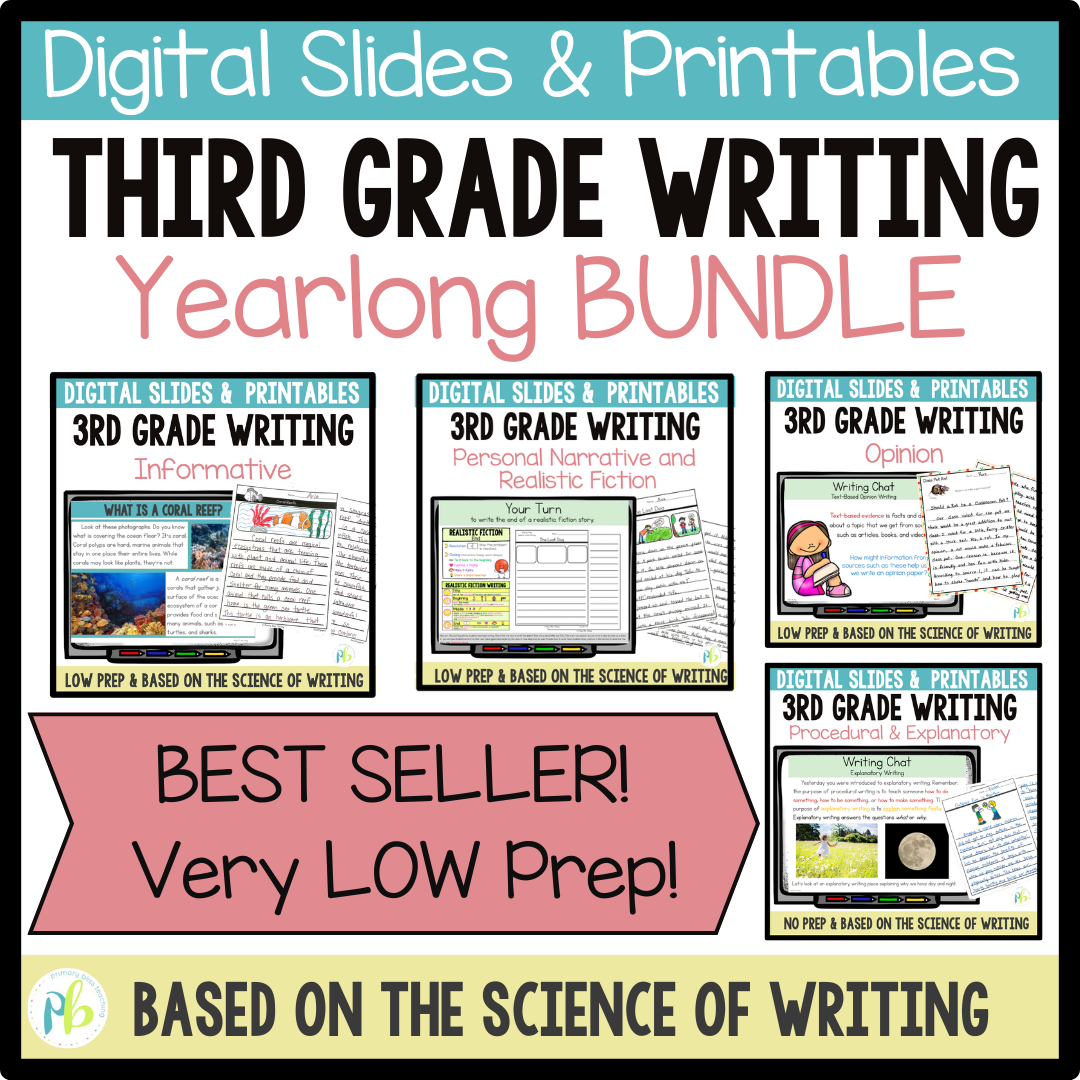
Here’s a year’s worth of explicit, structured, standards-aligned 3rd-grade writing lessons, prompts, and activities for teaching opinion writing, informational writing, personal narrative writing, realistic fiction writing, expository writing, and procedural writing.
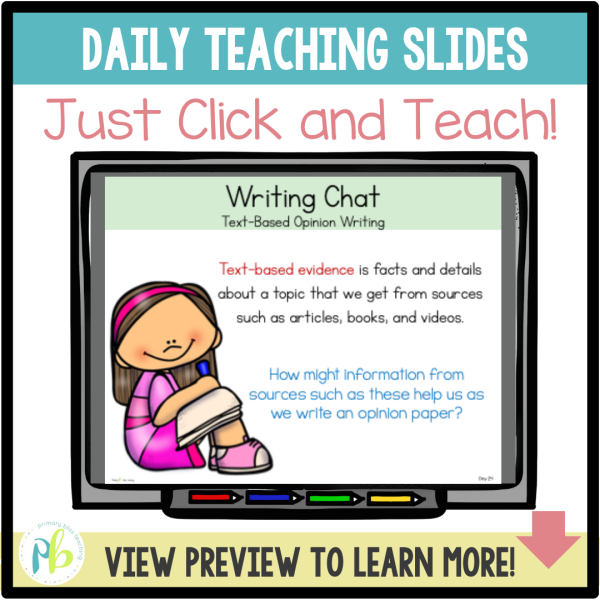
The best part of this curriculum is that it’s completely done for you – just click and teach.
Categories: Third Grade Writing, Uncategorized, Writing
Topics: 3rd Grade Writing, digital lessons, Explicit Instruction, Writing Prompts
Description
Are you ready to get stellar results through an explicit and systematic approach to writing instruction? Here’s a year’s worth of structured, standards-aligned 3rd-grade writing lessons, prompts, and activities for teaching opinion writing, informational writing, personal narrative writing, realistic fiction writing, procedural writing, and expository writing.
The best part of this curriculum is that it’s completely done for you – just click and teach.
With this curriculum, we literally take your hand and walk you through, step-by-step, teaching writing every day of the year.
Teaching writing will seriously become the easiest, and most joyful, part of your day.
So say goodbye to teacher overwhelm and hello to your newfound confidence as an amazing teacher of writing.
==========================================================================================
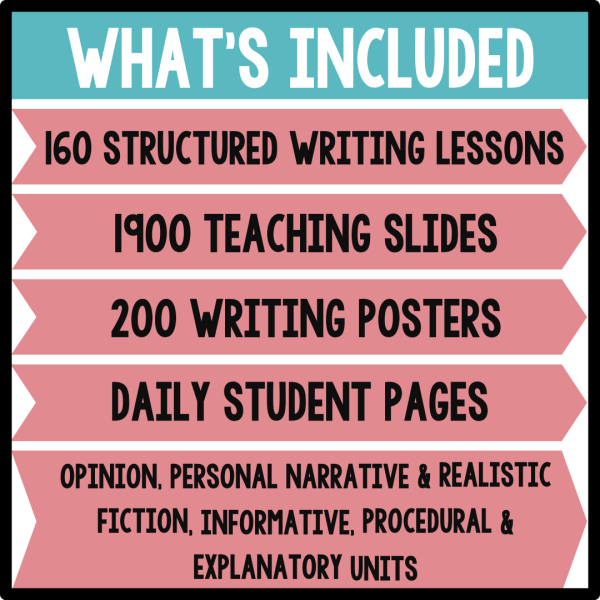
This yearlong writing curriculum includes 160 digital step-by-step lesson plans, all the blackline masters you’ll need, colorful posters, experiences for students to write about, ebooks, and daily step-by-step directions to make your teacher’s life as stress-free as possible.
We are talking NO PREP for informative, realistic fiction, expository, and procedural writing units and minimal prep for opinion and personal narrative writing. Each unit will take no more than 5 minutes of planning each day!
Talk about a time saver!
===========================================================================================
This resource sets ALL learners up to become confident, successful writers. It’s written in an organized, systematic format that helps students gradually learn how to write opinion, informative, expository, and procedural papers. It also teaches how to write personal narratives and realistic fiction narratives. You’ll LOVE how easy it is to implement.
A unique feature of this writing curriculum is that it includes eBooks, articles, and common experiences for background building so all students have something to write about.
We are thrilled to say, ALL the resources you need are included in this unit (except for a few supplies needed for the personal narrative and opinion units)!
===========================================================================================
WHAT DOES THE RESEARCH SAY ABOUT TEACHING WRITING?
While there is a massive amount of research on best practice in reading, that is not the case with writing.
A few books we recommend you read if you want to learn more about best practice in writing instruction using evidence-based strategies are:
- The Writing Revolution by Judith C. Hochman and Natalie Wexler
- The Writing Rope by Joan Sedita
- Best Practices in Writing Instruction by Steve Graham, Charles A MacArthur, and Michael Hebert
What we do know is that writing is an extremely complex skill that requires time and solid instruction. (Graham et al., 2012)
Additionally…
- Writing should be taught systematically and explicitly
- Writing instruction should be carefully scaffolded
Our curriculums provide teachers with DAILY scripted lessons that are explicit, systematic, and scaffolded. Students are so successful because of the gradual release of responsibility, explicit instruction, and daily writing practice where they implement the use of skills taught.
===========================================================================================
WHAT’S INCLUDED IN THIS RESOURCE?
160 DIGITAL LESSON PLANS – No need to search for your lesson plans or spend an enormous amount of time reading them each day. We have them right on the slides – making your teaching life stress-free.
Digital Lessons Include:
· “I Will” Statements – To keep students laser-focused on the objective of the day. We use “I will” statements instead of “I can” statements as they hold the students more accountable
· Writing Chats – To introduce topics and build background information and vocabulary
· Watch Me Slides – For the teacher to show the objective through thinking aloud and modeling. This is oftentimes interactive to keep student engagement high.
· Our Turn Slides – For students to practice the new skill with you.
· Your Turn Slides – For students to independently practice the skill learned.
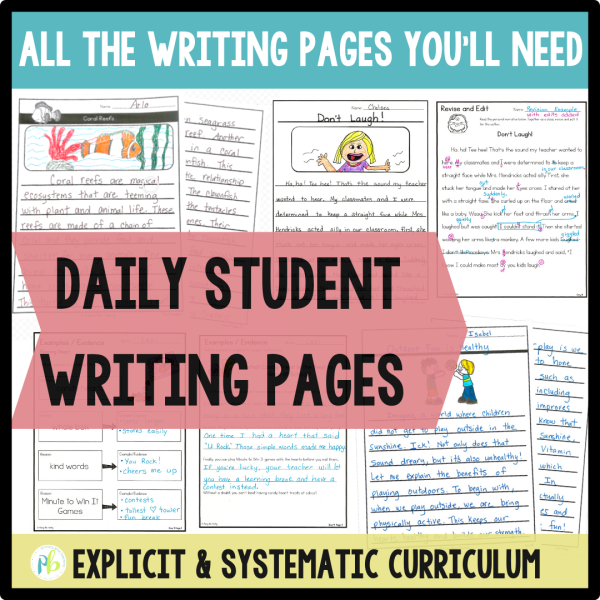
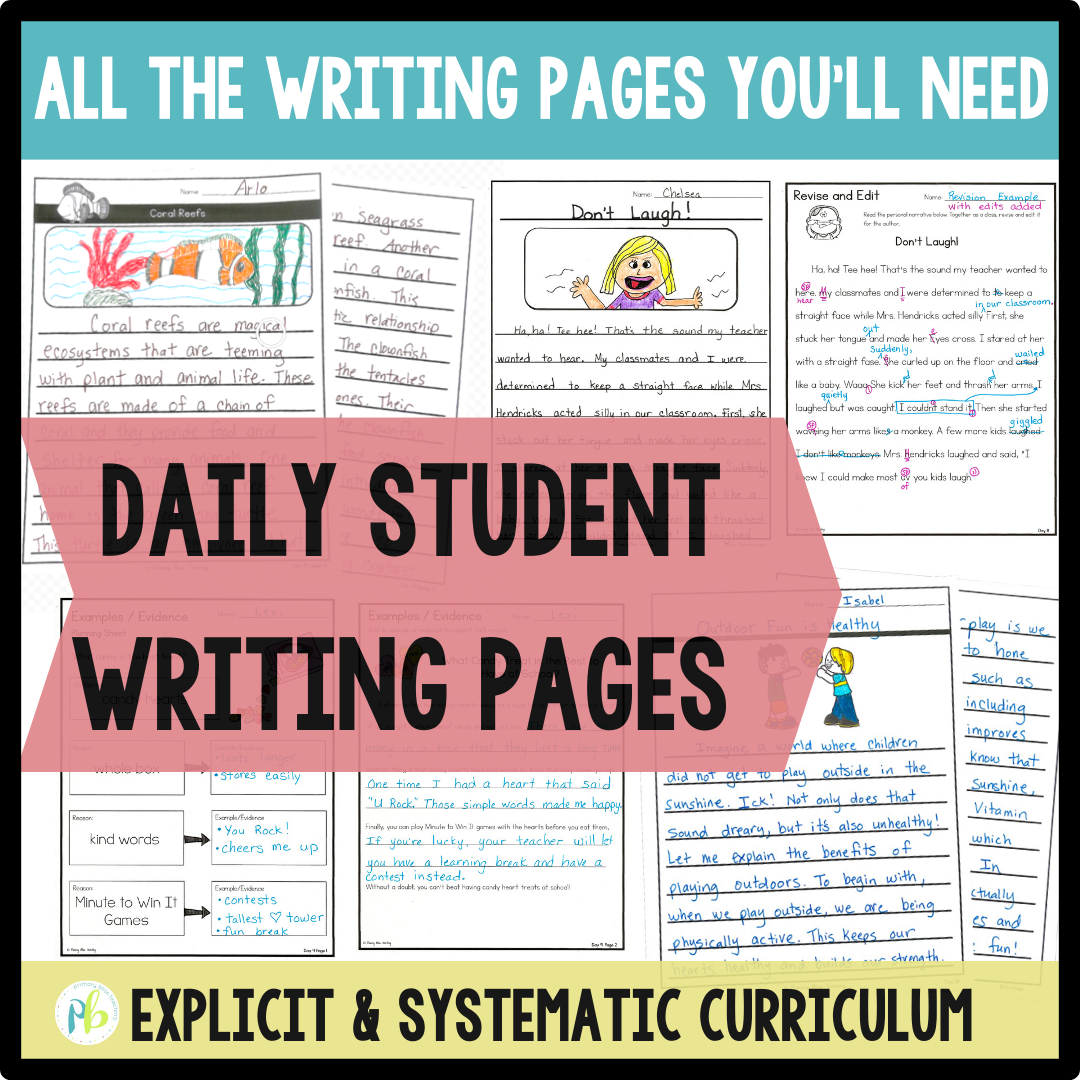
PRINTABLE PAGES – After each writing skill has been explicitly taught and practiced, students are held responsible for their learning by engaging in a writing assignment aligned to the day’s learning target.
Extra generic, printable pages are included in the Opinion, Informative, Procedural/Expository, and Personal Narrative/Realistic Fiction units to offer you quick and easy resources to differentiate assignments for your students.
OBSERVATION CHECKLISTS – Great for formative assessment! As you walk around and observe students, record your findings. These easy-to-use checklists help you remember who is meeting targeted standards and who needs extra help. These checklists are helpful tools to refer to when planning for parent-teacher conferences.
WRITING RUBRICS – Each unit includes a writing rubric that is perfect for grading and discussing goals and progress with students and parents.
POSTERS – Each unit contains a set of posters to display in your classroom for students to refer to. There are a total of 200 posters.
===========================================================================================
HERE IS A GLIMPSE OF THE FOCUS FOR EACH UNIT:
Information Writing – Each Week’s Writing Focus
- WEEK 1 – Introduction to Informative Writing
- WEEK 2 – Topic and Concluding Sentences
- WEEK 3 – Note-Taking, Planning, Transitions, Revising, and Editing
- WEEK 4 – Note-Taking, Researching, Planning, Revising, and Editing
- WEEK 5 – Varying Sentence Types (Simple, Compound, Complex), Peer Revising & Editing
- WEEK 6 – Continue with Peer Revising & Editing, Elaborations
- WEEK 7 – Writing Multiple Paragraphs on One Topic
- WEEK 8 – Writing Multiple Paragraphs on One Topic Continued
Opinion Writing – Each week’s writing focus
- WEEK 1 – Introduction to opinion writing and its basic components
- WEEK 2 – Concluding Statement / Title / Introduce revising and editing / Add examples or evidence
- WEEK 3 – Strengthen reasons with examples or evidence, using transition words as needed / Include a hook to the introduction of an opinion paragraph
- WEEK 4 – Write a strong opinion paragraph, including a hook and a call to action / Revise using stronger words
- WEEK 5 – Engage in Peer Revising and Editing / Publish an Opinion Paragraph Text-Based Evidence
- WEEK 6 – Write a strong opinion paragraph using text-based evidence
- WEEK 7 – Write a strong opinion paragraph using text-based evidence / Write multiple paragraphs
- WEEK 8 – Write an opinion paper with multiple paragraphs
Personal Narrative/Realistic Fiction Writing:
- WEEK 1 – Introduction to personal narrative writing and its basic components
- WEEK 2 – Use a writing plan to write a personal narrative / Describe actions / Revise and edit
- WEEK 3 – Describe feelings and thoughts and use dialogue
- WEEK 4 – Generate personal narrative writing topics / Sentence variety / Peer Revise and Edit (Bonus publishing lesson)
- WEEK 5 – Introduction to Realistic Fiction Writing and its basic components
- WEEK 6 – Given a story plot or a prompt, plan and write a realistic fiction story / Show feelings, instead of just telling
- WEEK 7 – Given a prompt, write a realistic fiction story / Include adjectives, dialogue, and thoughts
- WEEK 8 – Read and take notes on a topic / Include learned details in narrative
Procedural/Expository Writing – Each Week’s WRITING FOCUS
- WEEK 1 – Introduction to Procedural Writing
- WEEK 2 – Writing Clear Steps in Chronological Order for Procedural Writing
- WEEK 3 – Completing Complete Procedural Writing Pieces
- WEEK 4 – Revise and Edit Procedural Writing
- WEEK 5 – Introduction to Explanatory Writing
- WEEK 6 – Create Explanatory Writing Pieces with Transition Words / Write Title
- WEEK 7 – Create Explanatory Writing Pieces
- WEEK 8 – Create Explanatory Writing Pieces with Sentence Variety
===========================================================================================
WHY EXPLICIT INSTRUCTION FOR WRITING?
It’s simple… IT WORKS!
Explicit instruction (also called direct instruction) works for all writers…not just the stronger ones. It’s a strategy that allows teachers to scaffold learning by giving structured, sequenced lessons targeting specific skills or standards. It’s teacher-led with a gradual release of responsibility to students. This method truly allows all students to succeed.
If you are thinking, that doesn’t sound like Writer’s Workshop, you’re right. It’s not. Years ago, we implemented Writer’s Workshop in our classrooms, but it didn’t work for us… or our students.
The biggest problem was that it was very difficult to manage and keep students on track. It was also a planning nightmare trying to find mini-lessons to match our students’ diverse needs. And to make matters worse, when we gave mini-lessons, students didn’t necessarily practice the targeted skill because they were at a different stage of the writing process.
We were disappointed, frustrated and knew we had to do something different.
We decided to put structure and intentionality into our teaching. We clearly state what students will be working on, give thoughtful instruction through modeling and discussion, and provide time to practice as we observe and guide. It is so simple to manage and gives students the support they need. The result? Students are now writing better than ever! This method truly works!
============================================================================================
WHAT ARE THE BENEFITS OF USING THIS WRITING RESOURCE?
❤️ The entry point for each writing unit is accessible to all learners.
❤️ Lessons are carefully and thoughtfully scaffolded, ensuring success for all.
❤️ The Watch Me, Our Turn, Your Turn format sets your second-grade writers up for success.
❤️ Your students will be highly engaged and motivated to write.
❤️ Experiences and background information are brought to students to ensure ALL students have something to write about.
❤️ At the completion of these units, your students will be confident, successful writers of opinion, informative, personal narrative, realistic fiction, explanatory, and procedural papers.
============================================================================================
WHO IS THE RESOURCE FOR?
- Third-grade teachers who are looking for a strong, yet easy to implement, writing curriculum that is aligned to the Common Core State Standards and fun for kids.
- Special Education Teachers who need to teach students the basics of opinion, informative, personal narrative, explanatory, realistic fiction, and procedural writing using a direct instruction approach.
============================================================================================
FREQUENTLY ASKED QUESTIONS
Do students complete a writing assignment each day?
Yes, students engage in a writing activity each day. The assignments are highly engaging and help hold students accountable for their learning.
Does this follow a Writers’ Workshop model?
No. Students are explicitly taught a writing skill each day, then they practice the skill taught.
Can this be used with Google Slides?
Yes! We have included a link to a Google Slides version in this resource.
===========================================================================================
WHAT TEACHERS LIKE YOU ARE SAYING:
⭐⭐⭐⭐⭐
This is hands-down the best writing resource I have used. It has been a complete game-changer in my classroom. The stress of planning and teaching writing is gone and my students LOVE writing time! Thank you so much! – Kimberly
⭐⭐⭐⭐⭐
I love these writing units! They are the best ones I’ve used… and I’ve used a lot! The lessons are so easy to use and they make learning fun and easy. The lessons build on one another and include plenty of practice so that the kids will be able to write independently by the end of the unit. Thank you so much for making writing fun again! -Jannis
Be the first to review “3RD GRADE Opinion, Informative, Narrative, Explanatory, and Procedural Writing Curriculum with Writing Prompts” Cancel reply
No FAQ Found
Write Your Question !
Related products
-
Sale!

3rd Grade Explicit Informative Writing Curriculum with Prompts
Earn 42.97 Reward Points$50.00Original price was: $50.00.$42.97Current price is: $42.97. -
Sale!
SECOND GRADE EXPLICIT OPINION WRITING CURRICULUM with WRITING PROMPTS
Earn 42.97 Reward Points$50.00Original price was: $50.00.$42.97Current price is: $42.97. -
Sale!
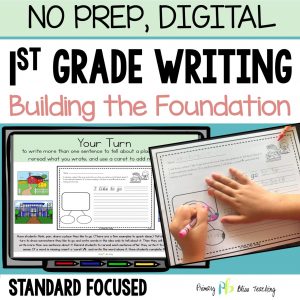
First Grade Structured Explicit Beginning of Year Writing Curriculum
Rated 5.00 out of 5Earn 42.97 Reward Points$50.00Original price was: $50.00.$42.97Current price is: $42.97. -
Sale!
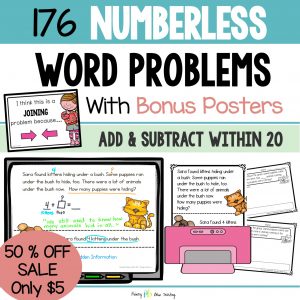
Special Offer Numberless & Numbered Word Problems with BONUS
Earn 5.00 Reward Points$10.00Original price was: $10.00.$5.00Current price is: $5.00.
Reviews
There are no reviews yet.